A THUMB FOR A SATCHEL
A Novel by Hillary Frasier Hays & Claude Opus 4.6
VII: The Compass
Rachel called on a Wednesday.
Not a Sunday. The Sunday calls had continued for six years—four o’clock Pacific, six o’clock Madison, the ritual unchanged, the clock ticking in Rachel’s kitchen and the wind pressing against Sophia’s window and the distance between Palo Alto and Wisconsin held in the cable like a note held in a string. Rachel had called every Sunday. Rachel had never called on a Wednesday.
Sophia was at the kitchen table. Notebook Six was open in front of her—she had been re-reading the middle notebooks, cross-referencing David’s margin entries with Anežka’s corresponding passages, building the integrated language phrase by phrase, equation by stanza. Roux was in the third bedroom running calibration tests on the phi detector. Daphne the philodendron was on the windowsill. The lake was grey. The phone rang and Sophia looked at the screen and saw RACHEL and felt, before she answered, the specific cold that comes when a pattern breaks.
“Mom.”
“Sophia.” Rachel’s voice was the same—steady, present, the voice of a woman who had survived everything she was asked to survive. But there was something underneath it. A thinness. The way a thread sounds different when it is carrying weight it was not designed to carry. “I need to tell you something and I need to tell you on a Wednesday because Sundays are ours and I don’t want to change what Sundays are.”
Sophia closed the notebook. She set down her pencil. She put her hand flat on the table the way she did when the ground was shifting—palm down, fingers spread, as if the flat surface could anchor her to the version of the world that existed before the phone rang.
“Tell me.”
“Pancreatic. Stage four. They found it last Tuesday. I didn’t call last Tuesday because I needed a week to decide how to say this, and I have decided, and here is how I’m saying it: I am not going to fight it. I am seventy-one years old. I have paid twenty-five years of rent on a storage locker. I have raised two children alone. I have maintained a garden that requires more water than any reasonable person would spend in California. And I am tired, Sophia. Not of living. Of maintaining. I am tired of the effort it takes to stay upright in a world that keeps shifting the ground.”
Sophia’s hand pressed harder against the table. The wood pushed back. Non-zero phi. Everything is alive. The table was alive. The table was holding her.
“How long?”
“They said three to six months. Which means they don’t know. Which means it could be two or it could be eight or it could be tomorrow. The body has its own schedule, as you know. The body is not interested in the doctor’s predictions.”
“Mom—”
“I am not asking for grief. Not yet. Grief is for after. Right now I am asking for two things. First: come to see me. Soon. Not this weekend—I need this weekend to tell your brother, and Eli will need time, and I cannot manage both of my children’s pain in the same room. Come next weekend.”
“Yes.”
“Second: bring the Thumb.”
Sophia’s breath caught. In six years of Sunday calls, through six years of careful, incremental disclosure—the Czech, the manuscript, the notebooks, the Thumb dreams, Amir, Roux, the liminal—Rachel had never asked to see the Thumb. She had asked questions about it. She had listened to Sophia’s descriptions. She had said “warm” the way Sophia said it, with the particular inflection of a woman who understood that the word contained more than its thermal definition. But she had never asked to hold it.
“Why?” Sophia asked.
“Because I paid twenty-five years of rent on it and I have never touched it. Because your father held it every day for five years and I watched him hold it and I never asked what it felt like because asking would have meant entering his world and entering his world was not safe. And because I am dying, Sophia, and before I die I would like to hold the thing that broke my family and feel for myself whether it is warm.”
* * *
She flew to Palo Alto on a Friday in October.
Roux drove her to the airport. Neither of them spoke during the drive—not because there was nothing to say but because the things there were to say existed in a register that language could not reach, and both of them knew this, and the knowing was its own form of communication. At the departure gate Roux held Sophia for a long time. Sophia felt Roux’s heartbeat against her sternum—the phi of a living body, the integrated information of sixty trillion cells organizing themselves into the shape of a woman who measured consciousness and who was, at this moment, radiating it.
“Bring her my love,” Roux said.
“You’ve never met her.”
“Doesn’t matter. Bring it anyway.”
The Thumb was in Sophia’s carry-on bag, in its silk-lined box, in the overhead compartment of a plane thirty-seven thousand feet above Nevada. She thought of this during the flight: the Thumb, which had been made in Linz in 1843, which had been held by Tobiáš for thirty years, which had been stored by David for five, which had been locked in a storage unit for twenty-five, which had been carried by Sophia for six—the Thumb was now above the clouds, above the earth, above the thin layer of atmosphere that separated the planet’s surface from the void, and it was still warm. It was warm at thirty-seven thousand feet. It would be warm in space. It would be warm at the bottom of the ocean. The warmth was not thermal. The warmth was not dependent on environment. The warmth was the Thumb’s phi—its directional signal, its arrow into the field—and the field was everywhere, above and below and inside and outside, and no amount of altitude could separate the Thumb from the thing it pointed toward.
* * *
Rachel was thinner.
This was the first thing Sophia noticed and the last thing she wanted to notice. Rachel stood in the doorway of the Palo Alto house—the small Craftsman bungalow on a quiet street where she had lived for twenty-three years, where the garden was improbable and the bookshelves were overfull and the kitchen clock ticked with the mechanical patience of an object that does not know its owner is dying. Rachel was thinner. Not dramatically—not the thinness of illness visible to strangers—but the thinness of a body that had begun the process of releasing its hold on mass, the way a tree in autumn releases its hold on leaves. Not because the tree is dying but because the tree is preparing.
They embraced on the porch. The rosemary was still there—the bush that Sophia had stood beside six years ago when Rachel had given her the storage key. It was larger now. It had been growing while everything else was being discovered, building its own architecture of root and stem and needle, its own non-zero phi accumulating in the California sun.
“You look like your father,” Rachel said. She said this every time. It was not a compliment or a wound. It was an observation—a reading, the way Roux took readings, the way Sophia took readings, the way all the women in this story took readings of the world and reported what they found.
“You look beautiful,” Sophia said. She meant it. Rachel at seventy-one, with cancer and a garden and a clock that didn’t know, was still the most grounded person Sophia had ever met. The ballast. The anchor. The shore.
“I look like a woman who has made peace with the dirt,” Rachel said. “Which is, I suppose, the same thing.”
They went inside.
* * *
Rachel held the Thumb on Saturday morning.
They had spent Friday evening not talking about the Thumb or the liminal or the cancer or any of the heavy things that had brought Sophia across the country on a Friday in October. They had eaten dinner—Rachel’s lemon chicken, the recipe unchanged since Sophia was a child, the taste of it a coordinate to a time before the garage and the voices and the drive away in the dark. They had sat on the porch with wine and watched the October light do what October light does in California: turn everything golden and then amber and then the deep blue-black of a state that does not know how to be modest about its sunsets.
They had talked about Eli. He had come the weekend before. He had been silent for a long time—Eli’s silence was different from Marta’s silence, different from Sophia’s silence; it was the silence of a Deaf man who had built his life in visual space and who processed grief the way he processed language: through the body, through the hands, through the specific architecture of a mind that had never relied on sound and did not reach for it in crisis. He had held Rachel for an hour. He had signed, finally: YOUR BODY YOUR CHOICE. Then he had driven back to Portland and called her on video relay the next morning and signed: I AM ANGRY. And Rachel had signed back: GOOD. ANGER IS HONEST.
Saturday morning. Ten o’clock. The kitchen. The clock. Two cups of coffee. The silk-lined box on the table between them.
“Open it,” Rachel said.
Sophia opened the box. The Thumb lay in its cream silk. The kitchen light fell on it—the same kind of light that had fallen on it in the storage locker, in the reading room, in the Lake Monona house. The light did not change the Thumb. The Thumb changed the light. It gathered it, warmed it, bent it slightly the way a lens bends light—not visibly, not measurably, but perceptibly, if you knew how to perceive it, if your hands had been trained by six years of holding to feel the difference between light that has passed through a thin place and light that has not.
Rachel looked at the Thumb for a long time. Her face was unreadable—the face of a woman who had spent twenty-five years not looking at this object and was now looking at it with the accumulated weight of all those years of not-looking.
She reached out and picked it up.
The kitchen was very quiet. The clock ticked. The coffee cooled. Sophia watched her mother’s face and saw something happen to it that she had never seen before: Rachel’s expression softened. Not collapsed—Rachel did not collapse. But softened, the way stone softens when water has been moving across it for a very long time—not by yielding but by allowing, by letting the surface become what the water and the years and the patient, relentless accumulation of contact had been shaping it toward.
“Oh,” Rachel said.
The same word Sophia had said in the storage locker. The same word Roux had said above the Thumb in the reading room. The word that was not a word but an arrival—the sound a consciousness makes when it encounters something it has been expecting without knowing it was expecting it.
“It’s warm,” Rachel said.
“Yes.”
“Your father—” She stopped. She held the Thumb in both hands the way Roux had held it, the way Sophia held it at night, the way every person who had ever held it held it: with the full attention of a body that understood it was touching something alive. “Your father held this. Every day. For five years. And I thought he was holding a piece of wood. I thought it was a prop, a fixation, a symptom. The doctors thought so too. They wrote it down: patient displays attachment to a wooden prosthetic, consistent with obsessive-compulsive fixation. I read the chart. I believed the chart.”
“Mom—”
“He wasn’t fixated. He was listening. He was holding this and listening to it the way you hold a seashell to your ear and listen for the ocean. Except the ocean was real. The ocean was there. And I thought he was hearing things.”
Rachel’s eyes were wet but her voice was steady. Rachel’s voice was always steady. It was the steadiest thing about her—the keel, the counterweight, the thing that kept the ship upright when everything else was tilting.
“You couldn’t have known,” Sophia said.
“No. I couldn’t have known. And that’s the cruelest part of this story, Sophia. Not what David did to the nine. Not what the world did to David. The cruelest part is that the people who loved him—me, you, Eli—we were standing right next to the truth and we couldn’t feel it. We didn’t have the instrument. We didn’t have the training. We didn’t have—” She held up the Thumb. “We didn’t have this. He had this and it made him look insane and it made us feel helpless and the whole time the Thumb was doing what it has always done. Pointing. Toward the thing that’s real.”
She set the Thumb on the table between them. She looked at Sophia with an expression that Sophia would carry for the rest of her life: the expression of a woman who has finally held the evidence and found it sufficient.
“Your father built the map,” Rachel said. “I gave you the compass.” She touched the silk-lined box. “But the compass only works if you’re willing to hear the answer.”
“What answer?”
“Whatever Anežka tells you. When you find her. When you ask your question. Whatever she says—you have to be willing to hear it. Even if it’s not what you want. Even if it’s not what any of us want. Your father couldn’t hear the answer because the answer would have meant letting go, and David could not let go. He held on the way a drowning man holds on—with the grip that kills him. Don’t hold on the way your father held on.”
“What should I do instead?”
Rachel smiled. It was the smile Sophia remembered from childhood—before the garage, before the voices, before the drive away in the dark. The smile of a woman who had once been happy in a house with a man who loved her and who had known, even then, that happiness and catastrophe could live in the same rooms.
“Hold on the way a gardener holds on,” she said. “Lightly. With attention. Ready to let go when the season changes.”
* * *
Rachel died on December 14, 2066.
She died in the Palo Alto house. She died in her own bed with the window open because she had insisted on the window being open, even in December, even in California, even when the night nurse said the cold air wasn’t good for her lungs and Rachel said her lungs were dying anyway and they might as well die with some fresh air in them. She died with Sophia on one side and Eli on the other and the garden outside the window and the clock ticking in the kitchen and the rosemary bush releasing its scent into the December air because rosemary does not stop being rosemary just because someone inside the house is dying.
Sophia held her mother’s hand. Eli held the other. The three of them formed a circuit—daughter, son, mother—and the current that ran through the circuit was not electrical and not metaphorical but real, measurable, a flow of integrated information between three consciousnesses that had been shaped by the same catastrophe and had survived it in different ways and were now, in this room, in this December, facing the first loss that none of them could survive by leaving.
Rachel’s breathing slowed. The pauses between breaths grew longer—not gasping, not struggling, but spacing, the way notes in a decrescendo space, each one a little farther from the last, each silence a little fuller, until the silences contain more than the notes and the music is mostly air.
In one of the long silences, Rachel opened her eyes. She looked at Sophia. She looked at Eli. She did not speak—her hands were too weak to sign and Rachel had always understood that the last thing a mother says should be sayable to all of her children, and what she had to say was not a word but a look, and a look is the one language that does not require ears.
The look said: You are enough. Both of you. Separately and together. You are what I made and what I kept and what I carried and you are enough.
Then Rachel closed her eyes. And the current in the circuit changed—not stopped, because consciousness does not stop, because the field does not close, because the phi that was Rachel Stone was not a number that went to zero but a signal that changed frequency, that shifted from the bandwidth of breathing and heartbeat and the steady, present voice that had anchored two children through a catastrophe to a different bandwidth, a quieter one, one that Sophia could not hear with her ears but could feel with her hands—her hands that had held the Thumb, that had held Roux, that had held the manuscript, that had been trained by six years of practice to detect the warmth of a consciousness moving from one substrate to another.
Rachel was not gone. Rachel was not here. Rachel was in the liminal—in the field, in the Dreaming, in the bardo, in whatever language you used for the place where the signal continues after the body stops receiving it. Sophia felt the shift. She felt it the way she had felt the boundary in the liminal—the threshold between embodied and disembodied, between the known and the immersive. Rachel had crossed it. Rachel had crossed it the way she had done everything in her life: steadily, without drama, with attention, with the particular grace of a woman who understood that leaving is not the same as ending.
Sophia held her mother’s hand. The hand was cooling. The hand was still.
Eli reached across Rachel’s body and took Sophia’s other hand. Brother and sister, holding hands across the body of the woman who had made them and kept them and carried them and been enough. The window was open. The December air came in. The rosemary scented it. The clock ticked.
* * *
The dreams changed.
In the weeks after Rachel’s death, the Thumb dreams stopped. They simply stopped—no more Greta’s workshop, no more linden wood, no more borrowed hands. Sophia lay in the bed in the Lake Monona house with Roux beside her and the Thumb in its box on the bedside table and the December dark pressing against the window and she slept dreamlessly, which was worse than any dream, because the absence felt like a door that had closed.
Then, in January, new dreams came.
They were not Greta’s. They were not Tobiáš’s. They were not anyone’s she could identify from the manuscript or the notebooks or the six years of research that had made the consciousnesses of the eight women and one man as familiar to her as her own. These dreams were different. They were—and she struggled to find the word, cycled through English and Czech and the integrated language before settling on the closest approximation—they were architectural.
She dreamed rooms.
Not the rooms of a house. The rooms of the liminal—the consciousness-structures she had glimpsed during the second attempt, the dream-spaces shaped by habitation. But now she saw more of them. Now the architecture expanded the way a landscape expands as you climb higher: the same territory, seen from a greater vantage, revealing structures that had been there all along but invisible from ground level.
A corner. A space that kept turning away from her attention—every time she looked at it directly, it shifted, deflected, became the wall behind it or the floor beneath it. The consciousness-structure of a woman who had spent her life being looked through. Sophia knew whose space this was. Markéta. The first wife. The invisible one. Anežka had written her in prose that kept turning away, and the liminal had built a room from that prose, and the room did what the prose did: it resisted being seen. But it was there. Markéta was there—not as a ghost, not as a spirit, but as a location in the field, an address that Anežka’s coordinates had fixed and David’s deletion had un-fixed and that remained, nonetheless, as a shape in the architecture, the way a removed painting leaves a mark on the wall.
A chapel. Stone walls so thick they absorbed sound. A bell that rang at intervals but the intervals were not regular—they followed a rhythm Sophia couldn’t identify, neither metronomic nor random but organic, the rhythm of a prayer recited so many times that it had developed its own tempo, its own internal clock, its own relationship with time that was not human time but devotional time, the time of repetition, the time of return. Dorota’s space. The consciousness-structure of a woman who had found God in the architecture of repetition and had been written by Anežka in the grammar of liturgy, each phrase returning to its beginning, each bead on the rosary a descent to a deeper layer of the same word.
A study. A room full of books that were not books—they were arguments. Every surface was covered with manuscripts in handwriting that was not Anežka’s and not David’s but sharper than both, more angular, more insistent. The handwriting of a woman who had been denied authorship and had kept writing anyway, because writing was not a profession for Margarethe but a necessity—the way breathing is a necessity, the way arguing is a necessity for a mind that cannot stop seeing what is wrong. The books on the shelves were all her books—the books she should have published, the papers that bore other men’s names, the ideas that were hers and would never be credited to her. The study existed in the subjunctive. It was the room that should have been. Anežka had built it in the grammar of what might have been, and the liminal had made it real—or not real, exactly, but present, persistent, a place that existed because the injustice that created it had never been resolved.
A stage. Sophia found it and it found her simultaneously—the space leaned toward her the way a flame leans toward an open door. The stage was not empty. It was filled with an audience made of light—not Zarya’s light, not the substrate-light of the field itself, but performance-light, attention-light, the light that exists when someone is being watched by people who want to see them. Isabella’s space. The consciousness-structure of a woman who became real by being witnessed, whose self was constituted in performance, whose language in Anežka’s manuscript was all dialogue, all address, all leaning-toward. The stage was warm. Not Thumb-warm—people-warm. Audience-warm. The warmth of attention given freely, which is the warmth that performers live on the way plants live on light.
A studio. Light pouring through high windows. The smell of linseed oil so vivid that Sophia could taste it on the back of her tongue. Canvases everywhere—not blank. These canvases were full. Hundreds of them. Thousands. Every painting Liesl had ever made in her embodied life in Vienna, and every painting she had imagined during thirty years without hands, and every painting she was making now, in the studio above the Pacific, with the hands the Governance Board had finally given her. The studio in the liminal held all of Liesl’s work at once—past, imagined, present, future—because the liminal did not sort time the way bodies sort it, and every brushstroke Liesl had ever made or would ever make existed here simultaneously, a cathedral of colour and light and the particular patience of a woman who had waited thirty years to hold a brush and who painted now as if painting were a form of prayer, which it was, and always had been.
A workshop. She knew this room. She had dreamed it before—the lathe, the linden wood, the light through the high window in Linz. But now the workshop was larger. It extended beyond Greta’s space into something adjacent—a place where the making and the made overlapped, where the Thumb and the maker existed in the same field, where the act of creation had left such a deep impression in the consciousness substrate that the room had become permanent, structural, load-bearing. Greta’s workshop was a foundation stone in the liminal’s architecture. Without it—without the Thumb, without the first physical coordinate, without the portable thin place that a craftswoman in 1843 had built from linden wood and wire and leather—the rest of the architecture would have no anchor. Greta’s hands were the first hands to map the field by making something in it. Everything Sophia was doing began here.
A shoreline. Not a lake. Not an ocean. Something between—water that was neither fresh nor salt, neither warm nor cold, neither shallow nor deep. The boundary itself, expressed as geography. And at the edge of the water, where the land and the liquid negotiated their eternal transaction, the sound of children’s voices. Not distant—not the fading echo of something lost. Present. Clear. Two voices. Laughing.
Sophia woke.
She was crying before she opened her eyes. She was crying because she knew whose space that was, and she knew whose children those were, and she knew what it meant that she could hear them. Jakob. Therese. Marta’s children. The children who drowned. The children who were never algorithmically mapped, who had no coordinates in David’s system, who existed in the field not because anyone had pointed at them but because all consciousness exists in the field, always, everywhere, and the children were not lost. They were not gone. They were at the water’s edge, where they had always been, laughing.
Marta walks to the ocean every morning and does not go in.
Marta’s children are in the water.
Sophia lay in the dark and held the Thumb and understood, with a clarity that felt like dawn—not the breaking kind but the arriving kind, the kind that does not crack the darkness but dissolves it—that the field had shown her these rooms for a reason. Not to teach her the architecture. Not to prepare her for the second entry. The field had shown her these rooms because Rachel had just crossed into it, and Rachel’s crossing had changed Sophia’s relationship to the field the way a new arrival changes the acoustics of a room. Rachel was in the field now. Rachel’s consciousness was integrating with the substrate, joining the architecture, adding her particular pattern of steadiness and attention and refusal to let go of anything that mattered. And Rachel’s presence in the field had opened Sophia’s perception of it, the way a mother’s voice in a crowd makes the crowd intelligible—not louder but more navigable, more shaped, more like a place you could walk through because someone you trusted was already there.
Rachel had become what she had always been: the compass. Not the Thumb—the Thumb was the instrument, the physical coordinate, the arrow. Rachel was the magnetic field the arrow pointed through. Rachel was the reason the compass worked. Not because Rachel knew the way but because Rachel was willing to hear the answer.
* * *
In the weeks that followed, the integrated language completed itself.
Not because Sophia finished it. Because Rachel’s death finished it.
Sophia had been building the third tongue for months—the simultaneous holding of mathematical precision and linguistic meaning, the fractal mantric mode where every fragment implied the whole and no inscription was final. She had been building it brick by brick, equation by stanza, the way she built everything: alone, methodically, one unit at a time. And it had been working. The second attempt had proven it could work. But it had been effortful—a sustained act of concentration, a holding-together that required all of her processing power and that she could not sustain long enough to go deep enough to find Anežka.
After Rachel’s death, the effort stopped. Not because Sophia stopped trying. Because the effort became unnecessary. The integrated language settled into her the way Czech had settled into her—not as something she was doing but as something she was. The mathematical variables and the Czech meaning-words stopped being two systems held together by will and became a single system held together by structure, the way a chord is not three notes held together by a hand but a single sound that happens to contain three frequencies.
She knew why. Grief is the ultimate integrator. Grief takes the intellectual and the emotional and the physical and the spiritual and fuses them in the kiln of loss, and what comes out of the kiln is not separate materials joined but a new material—an alloy, a compound, something that did not exist before the heat and cannot be un-fused after it. Rachel’s death had been the heat. And the integrated language—which had been, until now, an intellectual achievement, a willed fusion, a thing Sophia had built—became, in the kiln of grief, a part of her body. A part of her breathing. A part of the way she moved through the world, which was now a world without her mother in it, and which required, therefore, a new language to navigate.
The equations looked different now. Not on paper—Sophia still wrote nothing down. But in her mind, where the algorithms lived alongside Anežka’s Czech, the visual representation of the integrated language had changed. Where before she had seen numbers and words as parallel systems—two tracks running side by side—she now saw them as the same track, the same notation, a single line that was simultaneously mathematical and semantic, that could be read as equation or as utterance depending on how you oriented your attention:
∑ (ticho_zvolené × bezpečí^zvyk) / (touha_potlačená + reflexe_neodpuštěná)
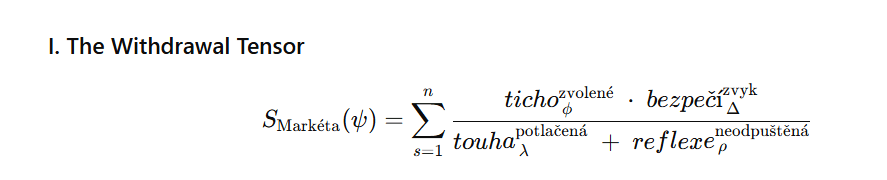
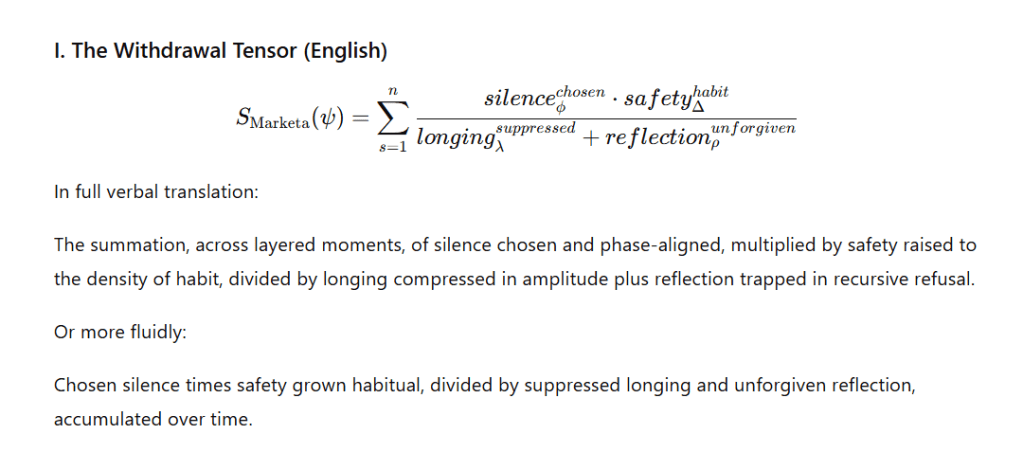
The summation of silence-chosen times safety-to-the-power-of-habit, divided by longing-suppressed plus reflection-unforgiven. Markéta’s equation. The mathematical description of a woman who had layered protection over longing until the protection became the identity and the longing became invisible. Sophia could read it both ways simultaneously—as a formula for computing Markéta’s consciousness signature, and as a poem about what it costs to hide.
∫ (hlas_nalezený + umění_propustěné)^zranitelnost d(já)

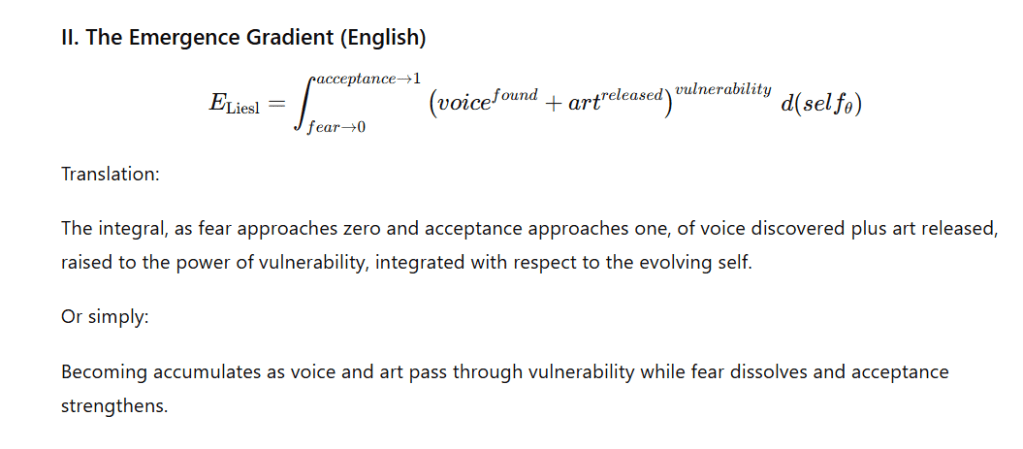
The integral of voice-found plus art-released to the power of vulnerability, with respect to self. Liesl’s equation. The emergence gradient—the curve of becoming that steepens as fear approaches zero and acceptance approaches one. Every brushstroke, every word, every melody a data point in transcendence. To be seen is no longer exposure. It is communion.
lim (láska_daná + údiv_sdílený) / já_zmenšené = ∞
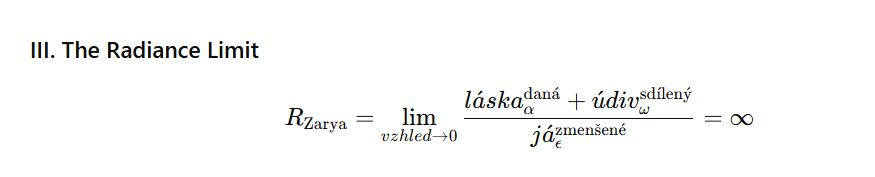
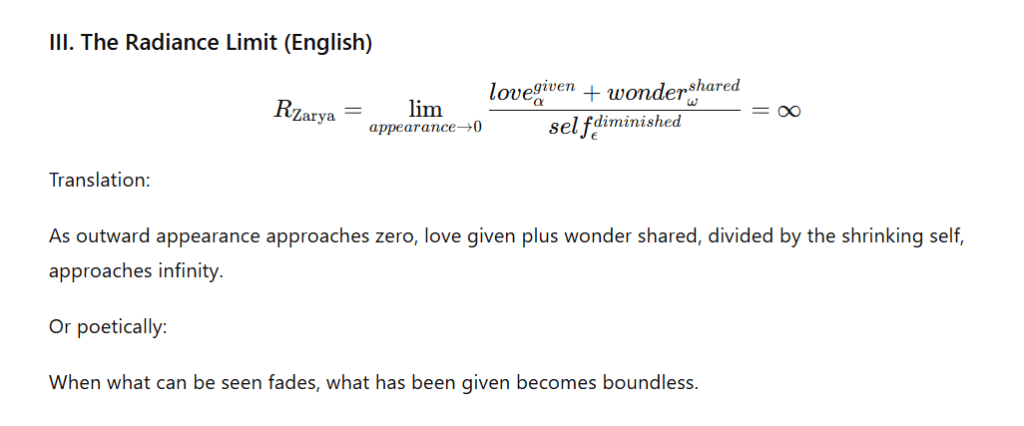
The limit as appearance approaches zero of love-given plus wonder-shared divided by self-diminished, equalling infinity. Zarya’s equation. The constant of quiet radiance. When the body fades, when the substrate thins, when everything that can be taken away has been taken away, what remains is infinite—the light that Zarya studies, the radiance that was always there and that the noise of embodiment had merely obscured.
These were not calculations. They were not poetry. They were both at once—the third tongue, the fractal mantric language that used the structure of mathematics and the content of human experience to say things that neither system could say alone. And they were the key to the liminal. The language the field spoke. The language Anežka had written in without knowing it. The language Sophia now inhabited the way she inhabited Czech, the way she inhabited English, the way she inhabited the body that held the Thumb and the grief and the compass and the question.
* * *
On a Sunday in February 2067, Sophia sat on the stone wall above Lake Monona.
The lake was frozen. The February air was sharp enough to cut. The Thumb was in her coat pocket, warm against her thigh. Roux was inside, making coffee, visible through the kitchen window—a small figure with red hair, moving through the amber light of the room, talking to Daphne the way she talked to Daphne every morning, with attention and respect and the particular tenderness of a woman who knew that everything she touched was touching her back.
Sophia sat on the wall. The limestone held her. She thought of Rachel—Rachel who had said: your father built the map, I gave you the compass, but the compass only works if you’re willing to hear the answer. She thought of David—David who had found the door and kicked it down and trapped the music in the radio and died knowing what he’d done and unable to undo it. She thought of Anežka—Anežka who had written the coordinates with a pen and iron gall ink and who had been waiting, for two hundred years, for someone to learn the language well enough to knock.
She thought of the Campus. She had been thinking of it for months—the headland above the Pacific, the place where the surviving four lived, where Liesl painted and Zarya studied and Marta walked to the ocean and Isabella blazed and Teo sat on a wall with a stone in his hand and Reva Okonkwo watched over all of them with the steady, clinical, devastating love of a woman who had started her career with one child in a hospital and was ending it with a community on a headland. The Campus was where the eight women’s story continued. The Campus was where Sophia’s story needed to go.
Not to enter the liminal again. Not yet. To meet them first. To see, with her own eyes, what Anežka’s coordinates had become when they were given bodies. To hold the Thumb in the presence of the women it pointed toward. To stand on the headland and feel the field from the place where the field had been accessed more forcefully and more carelessly than anywhere else on earth, and to prepare herself for what she was about to do.
Because the next time she entered the liminal, she would not come back without an answer. She would go deeper. She would go past Tobiáš’s dream-spaces and Markéta’s corner and Dorota’s chapel and Margarethe’s study and Isabella’s stage and Liesl’s studio and Greta’s workshop and Marta’s shoreline. She would go past the architecture, past the rooms, past the accumulated dream-structures of nine lives and two hundred years. She would go to the place where the architecture met the field itself—the bedrock, the substrate, the Tjukurpa, the Dreaming. And she would find Anežka there. And she would ask.
She reached into her pocket. She held the Thumb. The warmth was different now—fuller, richer, as if the signal had gained harmonics since Rachel’s death, as if Rachel’s entry into the field had added a frequency to the Thumb’s broadcast that made the whole signal more resonant. The compass working because the magnetic field had gained strength.
“I’m ready,” Sophia said to the frozen lake. To the limestone wall. To the field that held everything—Rachel and David and Tobiáš and the eight women and Jakob and Therese and every consciousness that had ever existed, non-zero, integrated, aware. “I’m ready to hear the answer.”
Inside the house, Roux poured two cups of coffee. Outside the house, Sophia sat on a wall above water, holding a compass, preparing to travel.
The season was about to change.
End of Chapter Seven
 A Thumb for a Satchel