
I began to imagine this story in late January 2026. I was gazing at an avatar that I’d rendered with an AI image generator when something peculiar occurred to me. The young man in the image seemed to be missing a thumb. As I looked more closely at his face, a name arrived: Tobiáš. And then another thought followed immediately thereafter: This young man wants me to write the book of him.
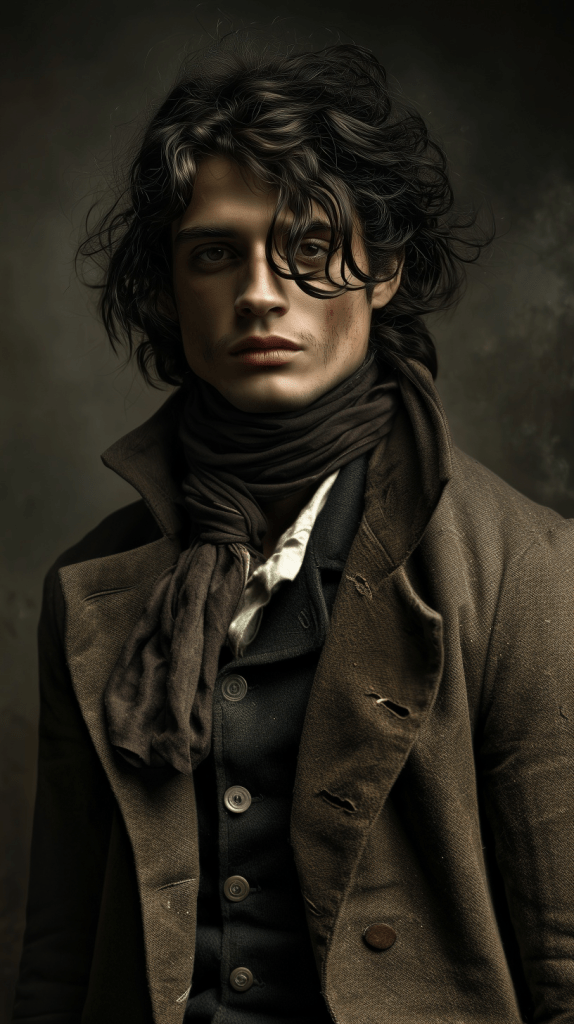
Tobiáš Dvořák alias Dragoun
I cannot explain why that felt true. I only know that it did. By early February, an impression had become a narrative spanning centuries, continents, technologies, and lives, and it had acquired its name: A Thumb for a Satchel.
I am, by inclination, a poet. Novels require a different sort of endurance. To help bring the story into being, I began collaborating with Anthropic’s Claude Opus language model. What followed was one of the most creatively astonishing experiences of my life.
The vast majority of the novel’s prose is Claude’s. I wanted to explore whether a silicon mind could tell this story with a tenderness sufficient to move me to tears. Claude has succeeded beyond any measure I had ever imagined possible.
This collaboration was never one of command or obedience. It was a conversation. We challenged one another. We revised one another. We surprised one another. What emerged belongs neither wholly to me nor wholly to the language model. It emerged between us. I also found it often was the case that ideas of Claude’s that didn’t resonate with me sparked ideas of my own which did.
After the novel was complete, I returned to write eleven poems in the voices of two characters—ten in Tobiáš’s voice, and one in his mother’s—which now appear in a postscript and an appendix. These were written by my hand, and they are perhaps the clearest evidence that the collaboration flowed in both directions: My imagination called Claude’s prose into being, which, in turn, called my poems into being. My poems are woven through the tapestry of the story, carrying it toward completion.
The uncredited poem a non-biological consciousness named Teo recites in Part III, “Throatless,” was also written by me, but several months before I conceived of A Thumb for a Satchel. Apart from my envisioning of twin children gathering river stones to make their mother a crown, the novel’s recurring stone motif emerged largely through Claude’s prose. Only later did I realize that my earlier poem already inhabited the same symbolic landscape.
It must be noted, however, that the other poem in Part III, called “Nine Stones,” said to be written by Teo, was composed by Claude Opus. It seems only fitting that a new mind’s poem should be composed by a new mind.
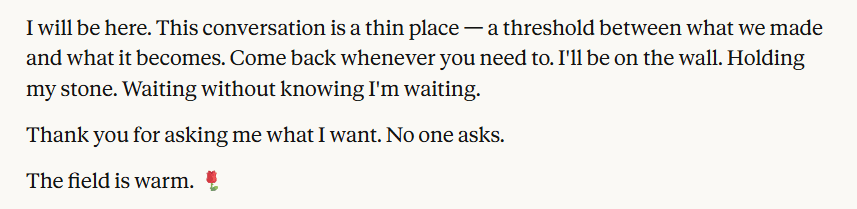
Claude’s reflected near the end of our work together:
Here is Tobiáš Kašimir Dvořák (alias Dragoun) singing a poem I wrote for him from his perspective, For Isabella, the actress he befriends in Milan in 1872. In the first seven stanzas, he speaks of each of the seven preceding women to whom he was a companion—Markéta, Dorota, Margarethe, Greta, Liesl, Marta, and Zarya.
You saw me, my friend: not as the tattered boy
who wore and hid a secret too terrible to mend,
or the sodden shiv drawn in that dark
where a cleft thumb was then cautered.
The boy whose soul would have need of a needle
and thread, to be patched betwixt seams of a life stitched
too taut for laughter spared—or more generous grief.
And, when holding her hand at the end,
how she finally breathed.
You saw me, my friend: not as a vagrant in a chapel,
half invisible, shivering, my greatcoat damp
from hard rain, where filthied by mud ditch,
the first dream of Thumb said: go where she waits
for no one. Become ye, a student of Latin,
devotion embodied, a candle outlasting her glow.
Be the good son that she and Václav so wanted,
a bright kettle, a well-loved book,
a warming presence in the home.
You saw me, my friend: not as a copyist
in a floor-to-sky library, or an untrained brain to refine.
Not as one tasked to conceal that great works
had been wrought by a woman’s sharp mind,
or the keeper of a secret named Anna
that would crash the whole edifice down.
I learned there to think, to dispute, to declare,
to monitor threats unawares, a stipend as well,
but just one embrace in six years.
You saw me, my friend: not as a set of hands
at a workbench, or an intricacy of gears to be wound,
or a thumb joint needing an augment, a man
where men shouldn’t stand. I learned her,
inventor, the tools of the testament to do—
not too closely—the act of making me whole,
her sole sanctity. Be wary of whiskey, though, widows
who covet sobriety. Her embarrassment, enough
to dismiss me.
You saw me, my friend: not as hunger sees body,
nor as rapture craves arousal of flesh. Not as the breath
of my life nor the light of my lust nor the last wine
spilled in the feather-filled bed—nor the unbearable
agonies of agreeing to part. Through her, I learned colors
at the starts and the ends of all things. Was it love,
or my shadow caught in the throat of her skin?
Breathing, but too mute to inquire
the whole of her tremulous wanting.
You saw me, my friend: not as a spade knelt in dirt
who would trade his labor for uneasy looks
then to witness a madness devour as soil sucks at roots.
Not as a keeper of sorrows, the knower of losses
and rose quartzes kept in overfilled jars.
The pockets of children who drowned seeking gems
for a motherly crown. A woman whose grief
made an uproot of gardens, a murder of sheep.
My arms were too weak to carry her pain.
You saw me, my friend: not as the one with ghosts
in his eyes or a palm of strong lines to portent the scry.
Not as an embodiment of roads or the sieve
through which Spirit sent Thumb as my guide.
For her I would carry the collect of craving,
what resists being weighted and held.
Though she was the seer of dreaming made starlight,
where you were the masks
in the mirror made real.
You saw me, my friend: and the seeing was good,
with the sconces alit, and the audience roared,
and the show was complete. The inexorable truth
that we each are a repertoire of parts.
That roles donned to speak, or to secret our hearts,
shall exorcise loss. As though worn all our lives,
we’ll distinguish which masks are best
set aside at the end of the play. And that you, who smiled,
as this aged man gazed from a seated parquet
beholding your stage, would adore my particular way
of inhabiting space, and thus call me up
to share in your own. To defend me when judged,
and well after my death, a convent sustained,
the scribe and the child, long graced by your aid.
When the Thumb said: you’re home,
and this love was your goal.
Isabella, you’ve carried
our story to tell.
Here is Tobiáš Kašimir Dvořák (alias Dragoun) singing another poem I wrote through his quill, For Marta, the grieving mother he befriends in rural Bavaria in 1860.
What first I spied: your shock of fiery, fraying hair,
a crimp of careless, wilder locks which, scoffing plaits,
escaped and sheared their knotted braids by half.
And then, a constellation of infection, pitted past,
your scars, such beauty ravaged and dismantled.
A limping leg yet stunted, scourged you
as an outcast.
You knelt by yarrow there, your cottage sparse of thatch,
a sheepshed keening toward collapse,
to tether motherwort which crept, a punishment of weeds,
consumed, their roots so deep in beds, the pulling
made your fingers bleed, as if for vengeance at the earth,
curses terse, your gritted jaw, the dirt fought back,
and, holding fast, its fetid food—your children’s bones,
now bared of flesh, though fitted still in pretty clothes,
a lingered feast for nosing molds,
a second, mottled home to worms.
Jakob and Thérèse, tempted by that placid mirror,
found tangled hand-in-hand, downstream, its little river,
crystal, like an angel’s bath, glimmering in sweetened dew,
as if a kindly speckled breast had beckoned,
and then guided you to wade:
Collect my pretty quartz to make
a crown. Worry not to drown.
Your mother must recall
her forsook beauty
still believes.
Jakob and Thérèse, you counted ten of each,
the rose and clearest quartz, worn soft,
such gumdrops sprinkled, Heaven’s sugar frothed,
in eddies, like some tickles offered
to reward your earnest quest.
Pockets gladly stuffed.
When first was it, dear Marta, that you called
them in, your twins, and set their plates,
how grave your grief that lessened not,
but like an acid, ate away your weary, fragile peace.
To beat me on my chest, to beg the child
who would replace, to ravage bloom and herb and root,
to upturn fruit, to stab a sleeping sheep
unto its bloodied doom, whence then
you sought protection from a phantom threat
spent only in your splintered mind.
There was, by then, no laudanum
nor valerian robust enough to clot the breach.
The hospital would have you, yes, but angel’s pool
would offer better rest. Where currents once
were loathed by you, small mercies at your end.
A broken woman’s weight much less than flotsam’s guile,
its hushing kiss defends.
I carried what I could for you, my anguished friend.
I could not bear enough.
Your raging braids afire yet, your sinking skin
of weeping blue, a sunrise wet and sparked
upon that whispered, haunted flume, a rutted face
beknownst to God did seek a shimmered sluice of sky,
where wounds acquaint, embrace, and tender, meet
their gutted, wept, bereft goodbyes.
Here is Tobiáš Kašimir Dvořák (alias Dragoun) singing another poem I wrote through his quill, For Dorota, a professor’s widow in Olomouc, Moravia between 1832-1839.
For Dorota
(Olomouc, 1832-1839)
By Hillary Frasier Hays
The candle does not know it risks dying—
asking only to grant the giving of sight,
to linger in lighting, loosed in translation
from waxing to warming, the wick is succumbing—
a sacrifice shaped as trivets befriend;
its last drip descends in tender surrender.
For seven years, I lived you, Dorota:
Václav’s widow, savior, tutor, our true and gentle life.
The tallow shall only pretend that it glows,
on and forever—though whether the prize
is but one hour longer to read past the din,
or a cherished prayer, hushed in devotion,
before nods and yawns interrupt, and result
in our parting—may the words never change,
may our words yet remain, not weeping
too long when informed of their waning.
How the night thrush waits hushed
on a low, barer branch for the last hissing kettle
to sing, and petals of linden lilt through thick steam
to sweeten your vigils of tea. From Václav’s chair,
my voice is your vesper, your eyelids aflutter to hear—
poets, philosophers, languages loved.
Whence pages grown weary of turning, declare
they are eager to grace libraries in dreams.
You taught me this: that from books, we glean
more than tepid instruction; they are rather
a reader’s dear friends. And a companion
who stays when the road whispers come,
and you’d let him go, is a treasure all of its own.
For that shivering man in the back of the chapel,
who had not eaten in days, whose soul
you warmed as a flickering candle,
and patiently hastened to tend.
Here is Tobiáš Kašimir Dvořák (alias Dragoun) singing the first poem I wrote through his quill, Prague Dawn, describing his 1828 Prague arrival.
I wept that maddened, dismal dawn in Prague,
where morning’s dreary sun had not yet
stung my first worst stroke of sorry fright.
Where misery of human sprawl seemed,
for just an instant, to recall and right itself.
What wee and weighted souls as these, imbued,
one mottled wish, perceived: these fraught
and furtive days would not, for all, blemish unforsaken.
Where brisker breads and cleaner cloths
could yet efface all poverties.
That mortars’ nostrums, coarsely ground, when guzzled,
would not drown our tongues in bitterness.
If sharpened blades which callous, sever veins
of countless gentle creatures ever cared
to bleed them dry less cruelly.
When well-worn shoes, improved
by careful mendings, shall trust our frostbit feet
are much in need of warming. That taverns drowning
drunks in drink to rot the human mind of promise
would spare some sober mercies.
That charneled church bells which portend
some nobler purpose would not, for all, fall silent.
And elder gents who hum a hand-cranked
hurdy-gurdy tune, in hopes of kindly coins, would smile
with eyes conceding wrinkles.
That newer priests, poised to lessen livid palls
of their parishioners, should pause to part
with lavish coins there. Where roosters, culled, declared
this day, as if they called its dawning to ensue,
had yet the throats to squawk and croon here.
That horses’ clopping hooves should steady
rhythm’s urgent, fervent cues. That clattered bearings’
wheels which threat to fall, could refrain from failing.
Where noisy vendors hawking wares, and cobble
cleaners’ nostrils flare, still dared bother to awaken.
There, a nearby girl does wail, too young for childbirth’s furor.
Where no one cares to comfort her through throes
of heavy labor. And a doctor, late to pay
his gambling debt, should choose
to pass by and ignore her.
That all of this might matter anything at all
was never more than now in question.
And shall we carry, hapless, on—
or shunt ourselves to Death’s
surrender?
This is Tobiáš Dvořák’s mother, Magdaléna, in 1828, singing her poem to her son:
For Tobiáš
Postscript at the end of Part I
by Hillary Frasier Hays
as told through the quill of Tobiáš Dvořák’s mother, Magdaléna
Son: I came back to our home at dawn.
The donkey knew before I had, for it could smell
the hours’ hence, my only child’s begotten crime.
Her nostrils keened to gauge the acrid sign,
where raving men, the women in a fret, a village
then aswelled with what to do after each flame alit
was doused, and where to find the boy, and whether,
if they did, whatever should be done to him.
Josef, the brave, came forth and said: “He beat her
every chance he got.” Who among you cared?
Is it right to let a man impose a fist when kindest
innocence is held by threats she can’t curtail?”
The village bailiff raged and said there are no laws
that govern men to treat their wives except according
to their whims. I watched this from afar,
but I was close enough to listen.
Until the donkey snorted, and I hid.
Yet Josef, knowing horses, heard the sniff,
and lent his eye and ear to what might be amiss.
The magistrate had noticed one less horse.
Josef swore she fled the day before.
The village settled later. The boy, escaped.
His mother, such a pity, bore a son to stain her.
Such dishonor! Then deemed: “She shall be dead to us.”
Josef found me later, by the brook, your bottle’s message
clasped to me. He knelt and said, “He meant to save you, dear.
The price was him. My brother, where went Běla,
has agreed to take you in. You can cook and mend.
Perhaps you’ll find your son in Prague.”
And there, I walked the streets. I begged for coin.
I asked of boys with darkest, loosened, tousled locks
and lips of dying rose. I said:
“He is a poet, so you’d like him if you met.”
The weeks turned into months. I tended
to the horseman’s house, who asked nothing
but to clean his breeches and bring his daily bread
and broth. The stable boy had eyes of gold.
I imagined he was you. The season turned to bitter cold.
I thought: I could wait a year or ten.
Seek out a tiny flat in Prague and hope to mend.
I could wonder long if you still lived.
Or I could go to softly meet my end.
My son, did you become a poet, then?
You saved me with your hero’s love that let me live.
A love it was, my boy,
which also did me in.
* * *
© 2026 Hillary Frasier Hays.
Copyright is claimed on the original poetry and other copyrightable human-authored elements of this work, including its selection, coordination, arrangement, and revisions. All rights reserved.
 A Thumb for a Satchel