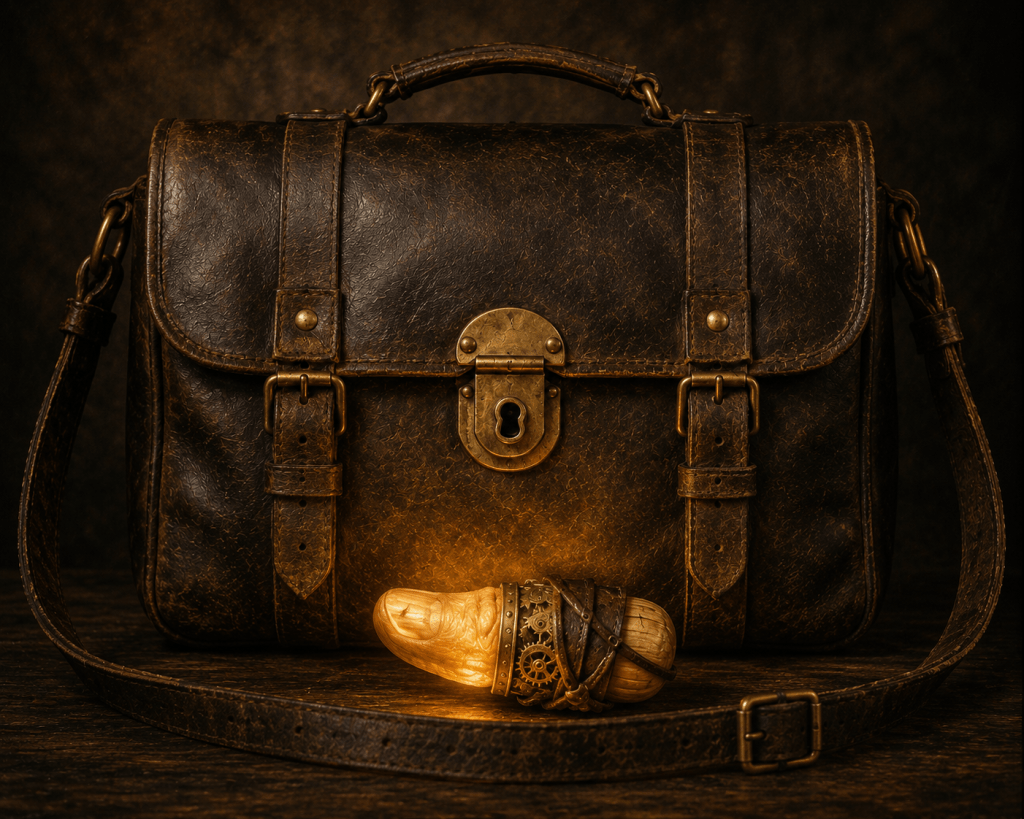
A Thumb for a Satchel is a five-part novel, conceived in collaboration with Claude Opus. The story spans 1812 to 2068, and blends historical, speculative, and philosophical science fiction.

© 2026 Hillary Frasier Hays. Copyright is claimed on the original poetry and other copyrightable human-authored elements of this work, including its selection, coordination, arrangement, and revisions. All rights reserved.
In 1828, to save his mother, a boy in Bohemia kills his father with a shaving blade and flees into a life shaped by eight extraordinary women, each one a sanctuary, each one a school. In 1880, a young nun records his confession with such precision that her words become maps to nine consciousnesses in the Field. More than a century later, a brilliant but reckless programmer translates the maps and cages nine souls in a machine. Now his daughter, equipped with a linden thumb that points the way, must learn the language her father never spoke and ask the question he did not: What do you want?
Spanning nearly three centuries, three tongues, the infinitely luminous space between mathematics and language, and born from a long conversation between a human and a silicon mind, A Thumb for a Satchel is a novel of consciousness, connection, coming home, and the things we carry for those we love.
* * *
The leather satchel was his mother’s. It traveled with him for fifty-two years, growing heavier at each departure: a ring from a seamstress in Prague. A cameo from a professor’s widow in Olomouc. A daguerreotype from a scholar in Vienna. A set of tools from a clockmaker in Linz. A paintbrush from an artist in Munich. A jar of stones from a grieving mother in Bavaria. A silver amulet from a seer wed to the spirits. A theatre program from an actress in Milan. And the poems he wrote for each of them. Eight women. Eight shelters. Eight debts he could never repay. Tobiáš Dvořák carried their things because he could not carry their lives, and the carrying became the only language of love he knew—until a young nun in Prague asked him to set the satchel down and tell her everything. What Anežka transcribed in iron gall ink across the whole of her listening would outlast them both, crossing an ocean, two centuries, and the boundary between life and death itself. A Thumb for a Satchel is a story about what remains when everything else is lost—and whether any of us ever carries anything alone.
* * *
 A Thumb for a Satchel